

The Institut Pasteur–UCSF QBI "Faculty Mini-Sabbatical Program" is designed to exchange top academic talents from the Institut Pasteur and the University of California San Francisco for one- to three-month visits to build knowledge and new partnerships. The purpose of sabbatical leave is to provide an opportunity for faculty members to engage in scholarly, creative, professional, research, or other academic activities that will enhance the faculty member's further contributions to their institution and the world in the name of scientific research and excellence towards pandemic preparedness. In this sense, the visiting scientists will get the opportunity to interact with leading scientists from either institution on their research programs.
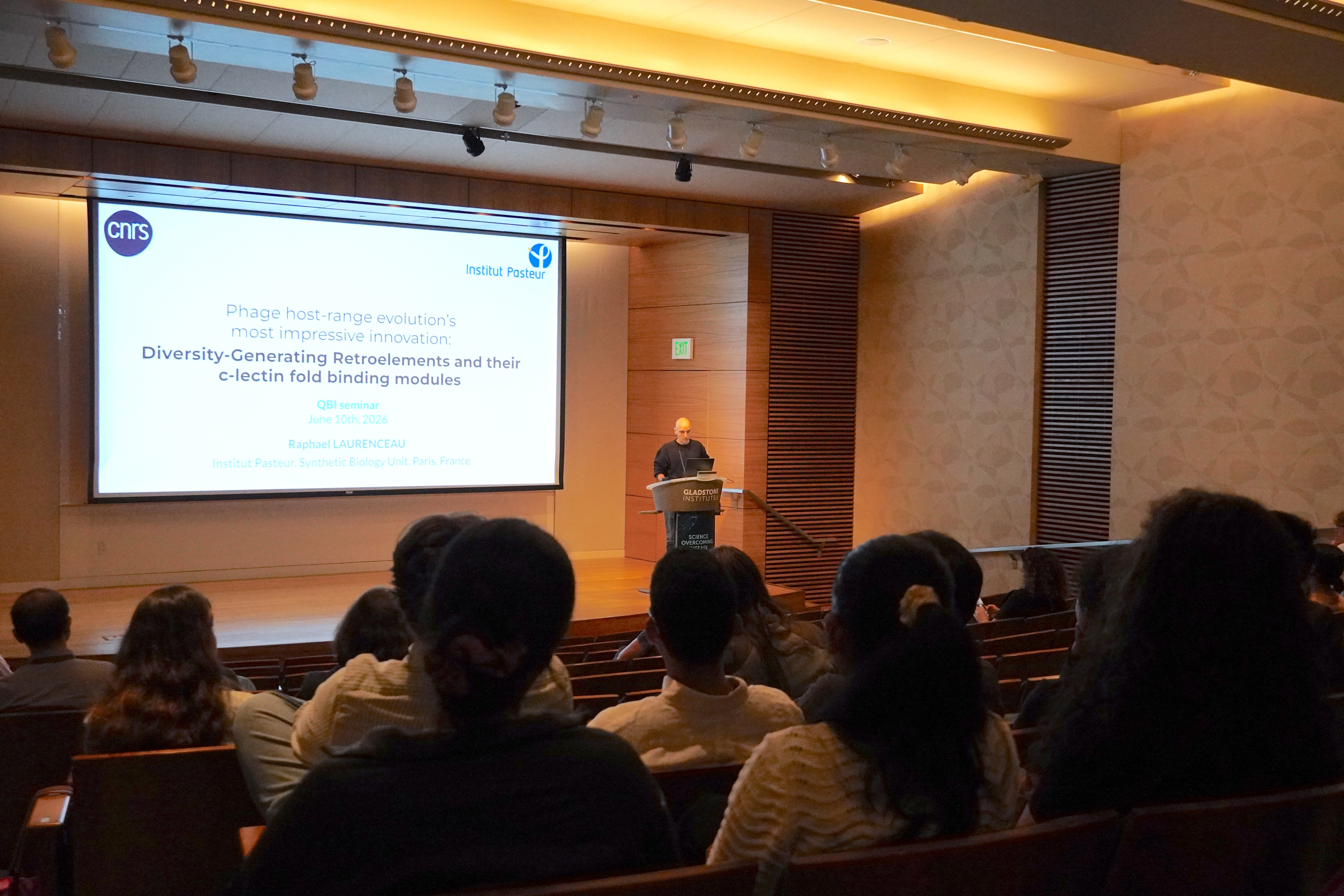
Raphael Laurenceau, CNRS Research Scientist at the Institut Pasteur, provides a reflection of his time at UCSF as part of the Mini Sabbatical Program.
My research sits at the interface of microbiology, bacteriophage biology, and synthetic biology. A central idea in synthetic biology is that evolution has already produced an extraordinary repertoire of molecular mechanisms, which we can study, understand, and eventually repurpose as new technologies.
My main project in recent years has focused on Diversity-Generating Retroelements, or DGRs. These are natural systems used by phages (viruses infecting bacteria) to generate enormous genetic diversity in their tail fiber and gain the ability to infect more bacterial hosts. We are developing DGRs into programmable tools for targeted mutagenesis, with the goal of accelerating the evolution of proteins with useful new properties.
What I find most exciting is the constant back-and-forth between fundamental biology and engineering. Nature has had billions of years to evolve extraordinarily sophisticated molecular systems, and we are still discovering mechanisms that we did not know were possible. Understanding how these systems work is fascinating in itself, but there is an additional thrill in realizing that a mechanism discovered in a bacterium or a phage could be transformed into a technology that many other scientists can use.
DGRs are a good example of this. They evolved as a solution to a very specific biological problem, generating diversity extremely rapidly while restricting mutations to a precise region of the genome. Once we understand that mechanism, we can ask a different question: can we reprogram it to evolve essentially any protein we choose?
I spent my mini-sabbatical in Seth Shipman’s laboratory at the Gladstone Institutes and UCSF. Our groups share a strong interest in natural retroelements and in turning unusual biological mechanisms into new genome-engineering technologies.
My work has primarily focused on DGRs, while the Shipman lab has developed extensive expertise in retrons, another fascinating family of bacterial retroelements. Over the past decade, they have transformed retrons into increasingly powerful tools for precise genome editing and have extended these technologies across different bacterial species and even into eukaryotic cells.
During my stay, we explored how some of the concepts and engineering strategies developed for retrons could be applied to DGRs. This was a natural continuation of our existing collaboration, which recently contributed to our work on extending DGR-based targeted mutagenesis beyond bacteria. The mini-sabbatical allowed us to go much further: we developed new DGR variants, identified modifications that substantially improve their activity, demonstrated DGR function in Klebsiella pneumoniae, and established a platform to experimentally evolve the system itself.
Science benefits enormously from bringing together people who approach similar problems from different directions. International collaborations give us access not only to complementary techniques, but also to different ways of thinking about a problem. In this case, our laboratories had developed expertise on two different classes of retroelements, and putting those perspectives together immediately generated new ideas.
What surprised me most during the mini-sabbatical was the difference in speed that physical proximity makes. Questions that might have required weeks of emails or several scheduled video calls could be discussed in front of a whiteboard in a few minutes, followed by an experiment the same day. Being embedded in the lab also gave me access to the Shipman lab’s very specific expertise in retroelement engineering, knowledge that is difficult to fully transfer remotely.
Just as importantly, being physically present creates opportunities for unplanned interactions. During my stay, conversations with researchers at Gladstone, UCSF, and the Joint Genome Institute led the project in directions I had not anticipated and opened the door to several new collaborations. That kind of scientific serendipity is very difficult to reproduce over Zoom.
The mini-sabbatical was not the conclusion of a collaboration, but rather the beginning of a more ambitious phase of it. We now have several concrete research directions that emerged directly from the experiments and discussions during my stay, and we intend to continue developing them jointly between Paris and San Francisco.
More broadly, the two months allowed me to build relationships with scientists well beyond the immediate project. My goal is to maintain those connections through joint projects, regular exchanges between our teams, and hopefully future visits in both directions. One of the great advantages of a mini-sabbatical is that after working side by side for two months, subsequent remote collaboration becomes much easier: you know the people, their expertise, and how they think, and an email or video call becomes the continuation of a conversation rather than the beginning of one.